


C10131v3 Bachelor of Medical Science Bachelor of Laws
Bachelor of Laws (LLB)
UAC code: 609065 (CSP), 619065 (DFEE)
CRICOS code: 025797G
Commonwealth supported place?: Yes
Load credit points: 240
Course EFTSL: 5
Location: City campus
Faculty/institute responsible: Law
Collaborating faculty/institute: Science
Overview
Career options
Additional assumed knowledge
Course duration and attendance
Course structure
Industrial training/professional practice
Course completion requirements
Course diagram
Course program
Honours
Professional recognition
Other information
Overview
The law is of special importance in many areas of medical science, including medical and health practice, medical and biological research and industrial and commercial enterprise. The Bachelor of Medical Science Bachelor of Laws is offered jointly by the Faculty of Law and the Faculty of Science. The program provides full-time study for students wishing to obtain a professional legal qualification that satisfies the requirements for admission as a legal practitioner, and study in Medical Science.
Graduates of this course understand the complex links between medical science and law, increasing their employability in both fields.
Career options
Career opportunities include legal practitioner in areas where a strong background in human biology, behavioural science, neuroscience or pharmacology is valued; researcher, officer or manager in private or public health health administration.
Additional assumed knowledge
English proficiency, mathematics, and at least one science subject.
Course duration and attendance
The course duration is five years of full-time study. Students who undertake either the Diploma in Scientific Practice (not available to international students) or the Bachelor of Medical Science (Honours) complete the course in six years of full-time study.
The Law component requires attendance at 10 to 15 hours of lectures per week and timetable constraints may require attendance at daytime and evening classes. The Science component requires attendance of approximately 24 hours per week at the University.
Course structure
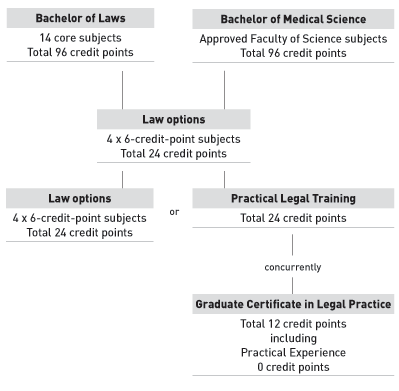
The course comprises a total of 240 credit points, and allows students to graduate with the separate degrees of Bachelor of Medical Science and Bachelor of Laws. The study components for course completion are as follows:
The Law component of 144 credit points is made up of:
- 96 credit points of compulsory core law subjects (14 subjects)
- 24 credit points of law options (four subjects), and
- either 24 credit points of practical legal training subjects (five subjects) or an additional 24 credit points of law options (four subjects).
The Medical Science component comprises 96 credit points of core Medical Science subjects.
Students graduate from the BMedSc independently from the LLB. However, to be eligible for graduation from the BMedSc students must have completed a total of 96 credit points of Faculty of Science subjects plus at least 96 credit points of Bachelor of Laws subjects.
Industrial training/professional practice
The Diploma in Scientific Practice (C20038), a period of industrial training, is available with an additional year of full-time study. It is not offered to international students. Admission to practise as a legal practitioner in NSW is based upon the successful completion of an undergraduate law degree (such as the Bachelor of Laws) plus an accredited course of practical legal training. Students can elect to attempt part of the practical legal training within the Bachelor of Laws in the final semester.
For more information about the practical legal training program, see:
Course completion requirements
| STM90378 Core subjects (Law UG) | 96cp | |
| STM90349 Core subjects (Medical Science) | 96cp | |
| CBK90042 Options | 24cp | |
| CBK90437 Options/PLT | 24cp | |
| Total | 240cp |
Course diagram
Course program
The standard program shown is for a full-time student who has elected to undertake practical legal training within the LLB. Students have the choice of commencing practical legal training within the LLB in the final semester of study or attempting an additional 24 credit points of Law options. Students who elect to undertake practical legal training within the LLB must concurrently enrol in the Graduate Certificate in Legal Practice (C11128). All options shown are Law options and are to be drawn from those on offer in CBK90042.
| Year 1 | ||
| Autumn semester | ||
| 70113 Legal Process and History | 10cp | |
| 70105 Legal Research | 4cp | |
| 65101 Chemistry 1C | 6cp | |
| 91101 Cells, Genetics and Evolution | 6cp | |
| Spring semester | ||
| 70217 Criminal Law | 6cp | |
| 70211 Law of Contract | 8cp | |
| 91701 Medical Science 1 | 6cp | |
| 65201 Chemistry 2C | 6cp | |
| Year 2 | ||
| Autumn semester | ||
| 70311 Law of Torts | 8cp | |
| 70616 Federal Constitutional Law | 8cp | |
| 68041 Physical Aspects of Nature | 6cp | |
| Spring semester | ||
| 91313 Biomolecules: Structure and Function | 6cp | |
| 91702 Medical Science 2 | 6cp | |
| 70317 Real Property | 8cp | |
| 70318 Personal Property | 4cp | |
| Year 3 | ||
| Autumn semester | ||
| 91703 Physiological Systems | 6cp | |
| 70417 Corporate Law | 8cp | |
| 70617 Administrative Law | 8cp | |
| Spring semester | ||
| 91704 Behavioural Sciences | 6cp | |
| 91705 Medical Devices and Diagnostics | 6cp | |
| 70516 Equity and Trusts | 8cp | |
| Select 6 credit points of options | 6cp | |
| Year 4 | ||
| Autumn semester | ||
| 91706 Neuroscience | 6cp | |
| 91707 Pharmacology 1 | 6cp | |
| 71005 Practice and Procedure | 4cp | |
| 71216 Law of Evidence | 6cp | |
| Spring semester | ||
| 71116 Remedies | 6cp | |
| 91708 Psychophysiology | 6cp | |
| 91709 Pharmacology 2 | 6cp | |
| Select 6 credit points of options | 6cp | |
| Year 5 | ||
| Autumn semester | ||
| CBK90182 Electives (Science) | 12cp | |
| Select 12 credit points of options | 12cp | |
| Spring semester | ||
| 75401 Litigation | 6cp | |
| 75402 Property Transactions | 6cp | |
| 75403 Commercial and Estate Practice | 6cp | |
| 75415 Professional Conduct 1 | 3cp | |
| 75416 Professional Conduct 2 | 3cp | |
Honours
Both degrees are available at Pass and Honours levels. The LLB with Honours requires candidates to complete the Research Thesis within the law option component. The rules relating to the LLB with Honours can be found in Undergraduate course information.
The BMedSc with Honours requires an additional year of study and is designed to introduce students to more advanced coursework and to research work in medical science. It allows eligible students to continue with postgraduate studies if desired and enhances their employment prospects.
Professional recognition
Supreme Court of NSW
This course satisfies the requirements for admission as a legal practitioner, provided students undertake the optional Practical Legal Training in the final semester. Depending on the Science subjects chosen, graduates may be eligible for admission to the relevant scientific professional organisation.
Other information
For further information on the Law component, contact the Law Information Office:
Inquiries about the Medical Science component can be directed to the Faculty of Science:
Dr David van Reyk
telephone +61 2 9514 2221
fax +61 2 9514 2228
email David.vanReyk@uts.edu.au

(CRICOS Provider No: 00099F)
Authorised by Director, Governance Support Unit
Last modified 6 August 2006 8:08 AM
Send comments about this page to Publications
Disclaimer | Privacy Statement | UTS homepage