


C10218v2 Bachelor of Arts in Communication (Information Management) Bachelor of Laws
Bachelor of Laws (LLB)
UAC code: 609004 (CSP), 619004 (DFEE)
CRICOS code: 040701F
Commonwealth supported place?: Yes
Load credit points: 244
Course EFTSL: 5.083
Location: City campus
Faculty/institute responsible: Law
Collaborating faculty/institute: Humanities & Social Sciences
Overview
Career options
Additional assumed knowledge
Additional recognition of prior learning
Course duration and attendance
Course structure
Industrial training/professional practice
Course completion requirements
Course diagram
Course program
Honours
Professional recognition
Other information
Overview
Information is essential to the functioning and interaction of individuals, social groups, communities, organisations and societies. The Bachelor of Arts in Communication (Information Management) Bachelor of Laws is offered jointly by the Faculty of Law and the Faculty of Humanities and Social Sciences. The course aims to provide students with a range of professional skills for designing, producing, accessing, communicating and managing information and knowledge, and the law.
This course is highly regarded both nationally and internationally. It develops a broad range of capabilities for professional practice in information and the law. Students learn to solve problems encountered in areas where the law intersects with the creation, organisation, retrieval and dissemination of information, particularly in electronic environments, and engage with pertinent ethical questions.
Career options
Career options include working in a range of social, organisational and technological contexts, such as legal practitioner in the information and knowledge industry; a career in the growth area of the world wide web, business information, managing digital data, designing information content, and managing information systems and networks.
Additional assumed knowledge
HSC English and computer literacy.
Additional recognition of prior learning
The Faculty of Humanities and Social Sciences has established recognition of prior learning packages with the following institutions for the courses listed:
- Insearch UTS: Diploma of Communication
- TAFE NSW: Diploma in Library and Information Services; Associate Diploma in Library Practice
- Temasek Polytechnic, Singapore: Diploma in Information Studies; Diploma in Library Studies
- School of Professional and Continuing Education, Hong Kong University: Higher Diploma in Library and Information Science
Course duration and attendance
The course is offered on a five-year, full-time basis, during which the Arts degree studies are integrated with studies in Law. Students are required to attend approximately 17 hours of seminars and lectures per week, and may be required to attend evening classes.
Course structure
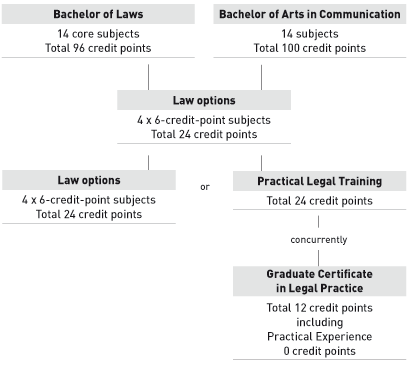
The course comprises 244 credit points and allows students to graduate with the separate degrees of Bachelor of Arts in Communication (Information Management) and Bachelor of Laws. The study components for course completion are as follows:
The Law component of 144 credit points is made up of:
- 96 credit points of compulsory core law subjects (14 subjects)
- 24 credit points of law options (four subjects), and
- either 24 credit points of practical legal training subjects (five subjects) or an additional 24 credit points of law options (four subjects).
The Arts component of 100 credit points is made up of:
- 36 credit points of compulsory first-year (100-level) subjects (six subjects)
- 56 credit points of subjects from Disciplinary and/or Professional Strands where specified (seven subjects), and
- 8 credit points of Elective Studies (one subject).
Industrial training/professional practice
Admission to practise as a legal practitioner in NSW is based upon the successful completion of an undergraduate law degree (such as the Bachelor of Laws) plus an accredited course of practical legal training. Students can elect to attempt part of the practical legal training within the Bachelor of Laws in the final semester.
For more information about the practical legal training program, see:
Course completion requirements
| STM90453 Humanities stream | 100cp | |
| STM90401 Law stream | 144cp | |
| Total | 244cp |
Course diagram
Course program
The standard program shown is for a full-time student who has elected to undertake practical legal training within the LLB. Students have the choice of commencing practical legal training within the LLB in the final semester of study or attempting an additional 24 credit points of law options.
Students who elect to undertake practical legal training within the LLB must concurrently enrol in the Graduate Certificate in Legal Practice (C11128). All options shown are law options and are to be drawn from those on offer in CBK90042.
| Year 1 | ||
| Autumn semester | ||
| STM90452 | ||
| 50105 Communication and Information Environments | 6cp | |
| 50107 Contemporary Cultures 1 | 6cp | |
| 50109 Power and Change in Australia | 6cp | |
| STM90386 | ||
| 50486 Information Management Practice | 6cp | |
| Spring semester | ||
| STM90452 | ||
| 50106 Media, Information and Society | 6cp | |
| STM90386 | ||
| 50487 Exploring Information Resources | 6cp | |
| STM90401 | ||
| 70105 Legal Research | 4cp | |
| 70113 Legal Process and History | 10cp | |
| Year 2 | ||
| Autumn semester | ||
| STM90386 | ||
| 50481 People and Information | 8cp | |
| STM90401 | ||
| 70217 Criminal Law | 6cp | |
| 70211 Law of Contract | 8cp | |
| Spring semester | ||
| STM90401 | ||
| 70311 Law of Torts | 8cp | |
| 70616 Federal Constitutional Law | 8cp | |
| STM90386 | ||
| 50482 Social Informatics | 8cp | |
| Year 3 | ||
| Autumn semester | ||
| STM90401 | ||
| 70317 Real Property | 8cp | |
| 70318 Personal Property | 4cp | |
| STM90386 | ||
| 50490 Information Design for Communicating | 8cp | |
| Select 6 credit points of options | 6cp | |
| Spring semester | ||
| STM90401 | ||
| 70417 Corporate Law | 8cp | |
| 70617 Administrative Law | 8cp | |
| STM90386 | ||
| 50491 Organising Information for Access | 8cp | |
| Year 4 | ||
| Autumn semester | ||
| STM90401 | ||
| 70516 Equity and Trusts | 8cp | |
| 71005 Practice and Procedure | 4cp | |
| STM90386 | ||
| 50493 Managing Information | 8cp | |
| Select 6 credit points of options | 6cp | |
| Spring semester | ||
| STM90401 | ||
| 71116 Remedies | 6cp | |
| 71216 Law of Evidence | 6cp | |
| STM90386 | ||
| 50172 Information, Society and Policy | 8cp | |
| Select 6 credit points of options | 6cp | |
| Year 5 | ||
| Autumn semester | ||
| CBK90318 Electives (Information Management) | 8cp | |
| STM90386 | ||
| 50190 Professional Information Project | 8cp | |
| Select 6 credit points of options | 6cp | |
| Spring semester | ||
| STM90102 | ||
| 75401 Litigation | 6cp | |
| 75402 Property Transactions | 6cp | |
| 75403 Commercial and Estate Practice | 6cp | |
| 75415 Professional Conduct 1 | 3cp | |
| 75416 Professional Conduct 2 | 3cp | |
Honours
The Bachelor of Laws may be awarded with First or Second Class Honours, which does not require an additional Honours year. Honours candidates must complete the Research Thesis within the law option component. The rules concerning the Bachelor of Laws with Honours can be found in Undergraduate course information.
Professional recognition
Australian Library and Information Association; Supreme Court of NSW
Graduates are eligible for professional membership of the Australian Library and Information Association. The law component satisfies the requirements of the Supreme Court of NSW for admission as a legal practitioner, provided students undertake the optional Practical Legal Training in the final semester.
Other information
For further information on the Law component, contact the Law Information Office:
Inquiries about the Arts component can be directed to the Faculty of Humanities and Social Sciences on:
email hss.studentcentre@uts.edu.au

(CRICOS Provider No: 00099F)
Authorised by Director, Governance Support Unit
Last modified 1 August 2006 1:07 PM
Send comments about this page to Publications
Disclaimer | Privacy Statement | UTS homepage