


C10134v4 Bachelor of Arts in Communication (Social Inquiry) Bachelor of Laws
Bachelor of Laws (LLB)
CRICOS code: 032311J
Commonwealth supported place?: Yes
Load credit points: 244
Course EFTSL: 5.08
Faculty/institute responsible: Law
Collaborating faculty/institute: Humanities and Social Sciences
Location: City campus
Overview
Course aims
Career options
Additional assumed knowledge
Course duration and attendance
Course structure
Industrial training/professional practice
Course completion requirements
Course diagram
Course program
Levels of award
Professional recognition
Other information
Overview
The Bachelor of Arts in Communication (Social Inquiry) Bachelor of Laws is offered jointly by the Faculty of Law and the Faculty of Humanities and Social Sciences. The course is designed for students who want to use their professional legal qualification together with social research, policy development and political advocacy. It aims to promote understanding of how communities and political systems work, along with positive and effective intervention skills. Students graduate with the separate degrees of Bachelor of Arts in Communication (Social Inquiry) and Bachelor of Laws.
The program provides full-time study for students wishing to obtain a professional legal qualification that satisfies the requirements for admission as a lawyer together with specialisation in social, cultural and communication theory and practice. Studies in social inquiry increase students' employment options in the diverse fields of social science, media and communication, as well as extending their knowledge of the broader context in which the legal system operates.
Course aims
The course aims to provide students with a range of professional and analytical skills grounded in sociology, social policy, politics, public history and international studies, for either legal or social science practice.
Career options
Career options include lawyer in business or media organisations, community or public sector, as advocates, policy makers, political activists, political advisers or social or media researchers.
Additional assumed knowledge
HSC English and computer literacy.
Course duration and attendance
The course is offered on a five-year, full-time basis. Students are required to attend approximately 17 hours of seminars and lectures per week, and may be required to attend evening classes.
Course structure
The course comprises 244 credit points. The study components for course completion are as follows.
The Law component of 144 credit points is made up of:
- 102 credit points of compulsory core law subjects (14 subjects)
- 18 credit points of law options (three subjects), and
- either 24 credit points of practical legal training subjects (five subjects) or an additional 24 credit points of law options (four subjects).
The Arts component of 100 credit points is made up of:
- 36 credit points of compulsory first-year (100-level) subjects (six subjects)
- 56 credit points of subjects from Disciplinary and/or Professional Strands where specified (seven subjects), and
- 8 credit points of Elective Studies (one subject).
Refer to the course entry in the UTS:Handbook 2007 for the pre-2008 course structure.
For a current listing of subjects in each course, refer to the Study Package directory in the UTS:Handbook 2008. In particular, refer to the correct structure of the PLT options, in CBK90437.
Industrial training/professional practice
To practise as a lawyer in NSW students must successfully complete an accredited legal qualification (e.g. Bachelor of Laws) and an accredited course of practical legal training (PLT), such as the UTS Practical Legal Training program.
Students enrolled in the Bachelor of Laws or combined Bachelor of Laws degrees have the option of completing the PLT program within their undergraduate law degree. Alternatively, students can complete their Bachelor of Laws by including further Law electives and undertake a postgraduate course in PLT, such as the Graduate Diploma in Legal Practice (C07075).
Course completion requirements
| STM90691 Law stream | 144cp | |
| STM90447 Humanities stream | 100cp | |
| Total | 244cp |
Course diagram
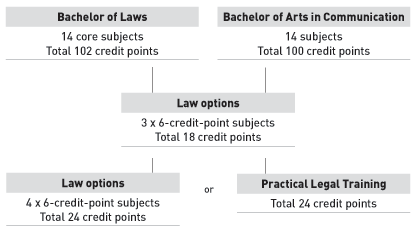
Course program
The standard program shown is for a full-time student who has elected to undertake PLT within the Bachelor of Laws. (Students have the choice of completing PLT within the degree in the final semesters of study or an additional 24 credit points of Law options.) All options shown are Law options and are to be drawn from those on offer in CBK90592.
| Year 1 | ||
| Autumn semester | ||
| STM90446 | ||
| 50105 Communication and Information Environments | 6cp | |
| 50107 Rethinking Culture | 6cp | |
| 50109 Power and Change in Australia | 6cp | |
| STM90382 | ||
| 50120 Introduction to Social Inquiry | 6cp | |
| Spring semester | ||
| STM90446 | ||
| 50111 Colonialism and Modernity | 6cp | |
| STM90382 | ||
| 50121 Theory and Method | 6cp | |
| STM90688 | ||
| 70115 Perspectives on Law | 8cp | |
| 70120 Legal Method and Research | 6cp | |
| Year 2 | ||
| Autumn semester | ||
| STM90382 | ||
| 50164 Research Methods 1 | 8cp | |
| STM90688 | ||
| 70311 Torts | 8cp | |
| 70218 Criminal Law | 8cp | |
| Spring semester | ||
| STM90688 | ||
| 70211 Contracts | 8cp | |
| 70616 Australian Constitutional Law | 8cp | |
| Select one subject from the following in CBK90016: | 8cp | |
| 50138 Community, Culture and the Social | 8cp | |
| 50139 Political Theory | 8cp | |
| 50140 Comparative Social Change | 8cp | |
| 50141 Australian History and Politics | 8cp | |
| 50142 Social Theory | 8cp | |
| Year 3 | ||
| Autumn semester | ||
| Select one of the following: | 8cp | |
| 50142 Social Theory | 8cp | |
| 50139 Political Theory | 8cp | |
| STM90688 | ||
| 70317 Real Property | 8cp | |
| 70327 Commercial Law | 6cp | |
| Spring semester | ||
| STM90688 | ||
| 70517 Equity and Trusts | 8cp | |
| 70617 Administrative Law | 8cp | |
| Select one subject from the following in CBK90030: | 8cp | |
| 50165 Research Methods 2 | 8cp | |
| 50166 Public History | 8cp | |
| 50300 Communicating the Social | 8cp | |
| Year 4 | ||
| Autumn semester | ||
| STM90688 | ||
| 70417 Corporate Law | 8cp | |
| 70717 Evidence and Criminal Procedure | 6cp | |
| Select one subject from the following in CBK90017: | 8cp | |
| 50183 Inequality and Power | 8cp | |
| 50184 Globalisation: Division and Change | 8cp | |
| 50186 Utopias and Dystopias | 8cp | |
| 50187 Comparative Belief Systems | 8cp | |
| 50484 The New World Politics | 8cp | |
| 50485 Gender, Culture and Power | 8cp | |
| Select 6 credit points of options | 6cp | |
| Spring semester | ||
| CBK90315 Electives (Social Inquiry) | 8cp | |
| Select one subject from the following in CBK90033: | 8cp | |
| 50222 Applied Research Project | 8cp | |
| 50260 Parliamentary Placement | 8cp | |
| 50217 Professional Placement | 8cp | |
| Select 6 credit points of options | 6cp | |
| Year 5 | ||
| Autumn semester | ||
| STM90688 | ||
| 75420 Ethics and Professional Conduct | 6cp | |
| 75421 Civil Litigation | 6cp | |
| Select one subject from the following in CBK90032: | 8cp | |
| 50163 Intercultural Interventions | 8cp | |
| 50220 Advocacy and Policy | 8cp | |
| Select 6 credit points of options | 6cp | |
| Spring semester | ||
| STM90687 | ||
| 75402 Property Transactions | 6cp | |
| 75403 Commercial and Estate Practice | 6cp | |
| 75411 Practical Experience | 0cp | |
| 75412 Legal Skills | 6cp | |
| 75413 Advocacy | 6cp | |
Levels of award
The Bachelor of Laws may be awarded with First or Second Class Honours, which does not require an additional Honours year. Honours candidates must complete the Research Thesis within the law option component. The rules concerning the Bachelor of Laws with Honours can be found in Undergraduate course information.
Professional recognition
Supreme Court of NSW
This course satisfies the requirements for admission as a lawyer, provided students undertake the optional PLT in the final semesters.
Other information
Further information is available from:

(CRICOS Provider No: 00099F)
Authorised by Director, Governance Support Unit
Last modified 10 August 2008 8:14 AM
Send comments about this page to Publications
Disclaimer | Privacy Statement | UTS homepage