Bachelor of Science, Bachelor of Laws
UTS course code: C10126
UAC code: 609060
Testamur titles: Bachelor of Science
Bachelor of Laws
Abbreviation: BSc LLB
Course Director (Science): Associate Professor Rod Buckney
Course fee: HECS (local); $8,000 per semester (international)
Total credit points: 240
Bachelor of Medical Science, Bachelor of Laws
UTS course code: C10131
UAC code: 609065
Testamur titles: Bachelor of Medical Science
Bachelor of Laws
Abbreviation: BMedSc LLB
Course Director (Medical Science): Associate Professor Graham Nicholson
Course fee: HECS (local); $8,000 per semester (international)
Total credit points: 240
Bachelor of Biotechnology, Bachelor of Laws
UTS course code: C10140
UAC code: 609067
Testamur titles: Bachelor of Biotechnology
Bachelor of Laws
Abbreviation: BBiotech LLB
Course Director (Biotechnology): Associate Professor Kevin Broady
Course fee: HECS (local); $8,000 per semester (international)
Total credit points: 240
Overview
Course aims
Admission requirements
Advanced standing
Attendance
Course duration
Course structure
Course diagram
Course program
Assessment
Honours
Professional recognition
Other information
Students from each of these degrees, subject to the fulfilment of the requirements described below, graduate with two testamurs. These combined degrees enable graduates to draw together the complex links between the sciences and law, increasing graduate opportunities in both fields. Students are encouraged to undertake the Diploma in Scientific Practice1, a period of industrial training providing excellent preparation for employment in the field.
Footnote:
1. The Diploma in Scientific Practice is not available to international students.
These courses aim to produce graduates with professional qualifications in science, medical science or biotechnology and in law and who are well prepared to pursue a career in either field. Such graduates may choose to practice law in areas such as environmental, patents and mining law where a strong background in science is of advantage. Alternatively they may choose to enter scientific careers, particularly as advisers, consultants or managers in industries where a knowledge of the law is of particular value.
The law is of special importance in many areas of medical science and biotechnology including medical and health practice, medical and biological research, and industrial and commercial enterprise. Hence, graduates could choose to practise in areas of law, such as certain types of litigation or criminal proceedings, where a strong scientific background in human biology, behavioural science, neuroscience, pharmacology, and molecular biology and biotechnology, is particularly advantageous.
Local students are required to apply for admission through the NSW Universities Admissions Centre (UAC). For school leavers, admission is based on UAI scores. Non-current school leavers should apply through UAC in addition to sending a Personal Statement to UTS. Applications are taken from August to end of October each year. Considerations for admission as a non-current school leaver takes into account the following:
- English proficiency and written expression
- previous legal study
- tertiary study
- legal experience or related employment
- motivation and the reason for wanting to study law (and other discipline in the case of a combined or double degree)
- commitment to study law, and
- supporting material such as professional and personal references and/or letter of employer's support.
International students should contact the UTS International Office for application procedures. In addition to academic requirements, students are required to meet English language proficiency requirements.
UTS recognises prior tertiary level learning, including that from other universities and TAFE (Associate Diploma and Diploma only). Once a student's application to study has been accepted, they may apply to receive recognition of successful prior learning, and may therefore be able to complete the course in less than the standard time. Applications for credits and exemptions should be made to the Office of the Associate Dean (Teaching and Learning) in the Faculty of Science.
Full-time attendance involves approximately 24 hours each week at the University. This enables a full stage of the course to be completed in one semester.
Each of these courses is offered over:
- five years, full time (students may be expected to attend some evening lectures)
- six years, full time with successful completion of the Diploma in Scientific Practice, or
- six years, full time with Honours.
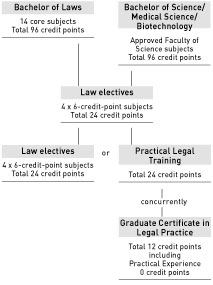
The study components and the requirements for course completion are as follows:
- The law component comprises at least 144credit points of study approved by the Faculty of Law.
- The science component comprises at least 96 credit points of study approved by the Faculty of Science, as outlined below.
For a student to be eligible for the Bachelor of Science degree, the science component must meet the additional criteria specified in (a)–(c) below.
(a) The science component must be sufficiently focused to enable the student to command a coherent and integrated body of theoretical and practical knowledge in at least one field of science.
(b) Within the total of 96 credit points, the value of science subjects that are normally offered in Stages 1 and 2 of an undergraduate course of the Faculty of Science must not exceed 42credit points.
(c) Within the total of 96 credit points, the value of science subjects that are normally offered in Stages 5 and 6 of an undergraduate course of the Faculty of Science must be at least 24credit points.
To be eligible for a separate Bachelor of Medical Science degree the student must complete the specified 96 credit points of Medical Science subjects.
To be eligible for a separate Bachelor of Biotechnology degree the student must complete the specified 96 credit points of Biotechnology subjects.
- On completion of the science, medical science or biotechnology component as set out in 2 above, a student who has also completed at least 96 credit points of law subjects approved by the Faculty of Law is eligible for the award of Bachelor of Science.
- A student who qualifies for the award of Bachelor of Science according to 3 above will, on completion of the law component as approved by the Faculty of Law, be eligible for the award of Bachelor of Laws.
- A student who completes 144 credit points of study approved by the Faculty of Law and 96 credit points of study approved by the Faculty of Science but does not satisfy the conditions set out in 2(a)–2(c) above will be eligible for the award of Bachelor of Science, Bachelor of Laws (single testamur).
Course diagram
 Year 1
Autumn semester
70113 Legal Process and History 10cp
70105 Legal Research 4cp
xxxxx Approved Science subjects 12cp
Spring semester
70217 Criminal Law 6cp
70211 Law of Contract 8cp
xxxxx Approved Science subjects 12cp
Year 2
Autumn semester
70311 Law of Tort 8cp
70616 Federal Constitutional Law 8cp
xxxxx Approved Science subject 6cp
Spring semester
70318 Personal Property 4cp
70317 Real Property 8cp
xxxxx Approved Science subjects 12cp
Year 3
Autumn semester
70417 Corporate Law 8cp
70617 Administrative Law 8cp
xxxxx Approved Science subject 6cp
Spring semester
70516 Equity and Trusts 8cp
76xxx Elective Subject 1 (Faculty of Law) 6cp
xxxxx Approved Science subjects 12cp
Year 4
Autumn semester
71216 Law of Evidence 6cp
71005 Practice and Procedure 4cp
xxxxx Approved Science subjects 12cp
Spring semester
71116 Remedies 6cp
76xxx Elective Subject 2 (Faculty of Law) 6cp
xxxxx Approved Science subjects 12cp
Year 5
Autumn semester
76xxx Elective Subject 3 (Faculty of Law) 6cp
76xxx Elective Subject 4 (Faculty of Law) 6cp
xxxxx Approved Science subjects 12cp
Spring semester
Practice Legal Training (PLT) 24cp
or
Four Law electives 24cp
For further details on approved science programs and subjects, see Recommended Science strands.
Depending on the subjects chosen, students can expect to undergo a variety of assessment types before completion of this course including formal and informal examinations, assignments and essays, practical reports and write-ups, and seminar presentations. Assessment tasks may be based on individual or group work. For further details on individual subjects, see the Subject descriptions section, or contact the subject's coordinator.
The Honours program is designed to introduce students to more advanced coursework and to research work in science. It allows selected students to continue on with postgraduate studies if desired and enhances their employment prospects. For further information, contact the Course Director.
Students completing these courses are able to apply for admission as either solicitors or barristers to the Supreme Court of New South Wales.
Depending on the science specialisation and subjects chosen, graduates may be eligible for admission to their relevant scientific professional organisation.
All academic inquiries relating to the science component of these degrees should be made to:
Office of the Associate Dean
(Teaching and Learning)
Associate Professor Rod Buckney
telephone (02) 9514 4044
fax (02) 9514 4095
email Rod.Buckney@uts.edu.au
For administrative queries, or inquiries relating to the law component of these degrees contact:
Faculty of Law
telephone (02) 9514 3444
|